01
AI Governance
Governance frameworks that align AI adoption with strategic goals, transparency, human oversight, risk management, accountability, and organizational capability.
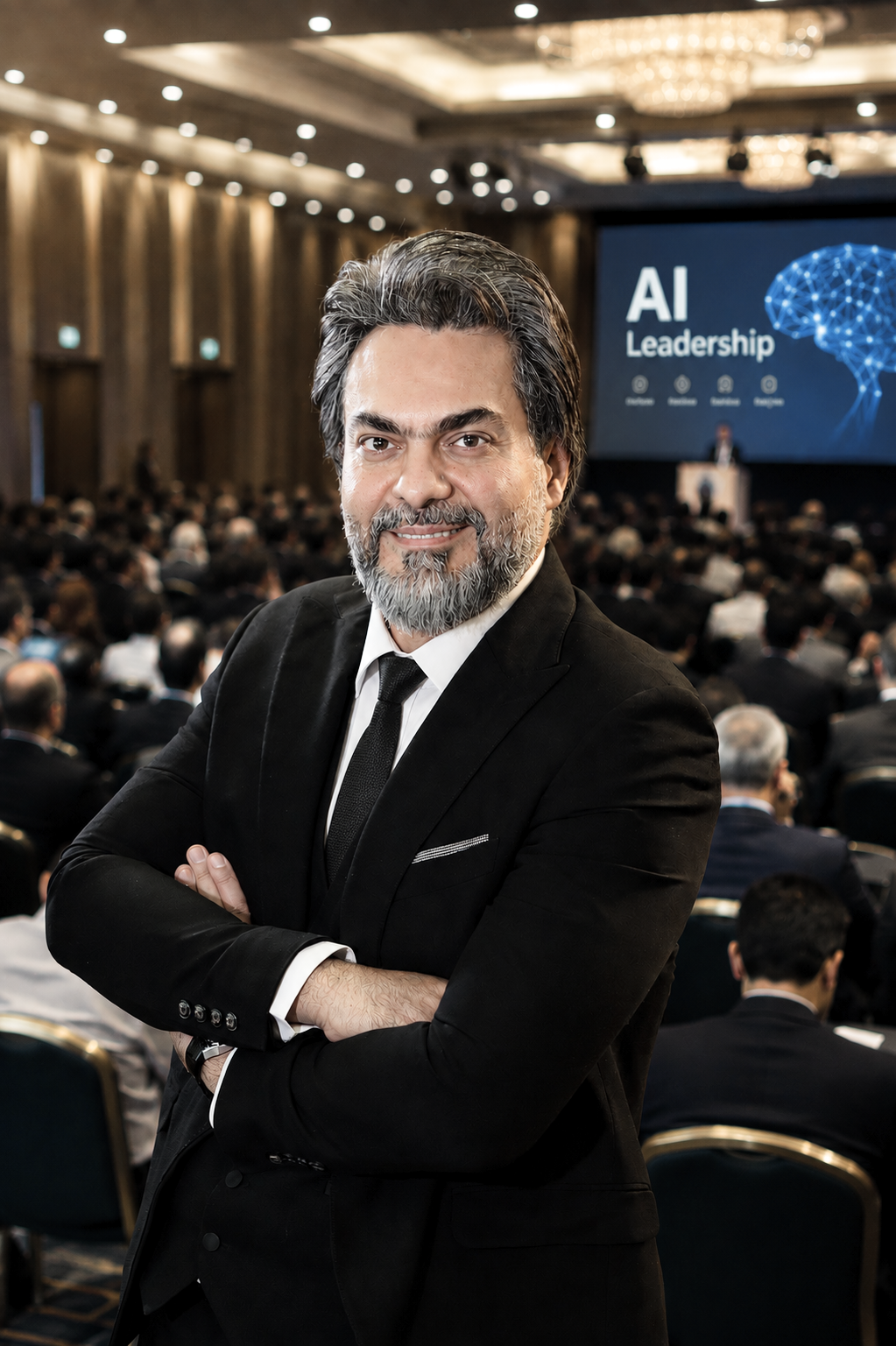
.png) Dr.Ali NazemAI Researcher · Executive · Strategist
RESEARCH / HUMAN–AI INTELLIGENCE
Dr. Ali Nazem's research examines how increasingly capable artificial intelligence systems can augment human cognition, decision-making, and leadership while preserving human agency, accountability, and independent judgment.
AI Governance · Human–AI Decision Systems · Cognitive Augmentation · AI Leadership
The central question is not only what AI can do for human performance today, but what repeated interaction with AI does to human capability tomorrow.
CORE RESEARCH AGENDA
Artificial intelligence is moving beyond automation and productivity support toward increasingly active participation in human reasoning, managerial judgment, and organizational decision-making. The research agenda examines how this transition changes the relationship between human cognition, intelligent systems, authority, accountability, and organizational design.
01
Governance frameworks that align AI adoption with strategic goals, transparency, human oversight, risk management, accountability, and organizational capability.
02
How decision authority, verification, oversight, escalation, and trust should be distributed between human decision-makers and AI systems.
03
How repeated interaction with AI can strengthen learning, calibration, reasoning, and independent judgment rather than create dependence.
04
How leaders and organizations can design intelligent decision architectures that expand human capability without displacing human responsibility.
LONGITUDINAL HUMAN–AI OUTCOMES
Sustained AI collaboration may produce different long-term effects on human cognitive capability. Research aims to test these possibilities under different conditions rather than treat any one outcome as universal.
AI interaction strengthens human reasoning, learning, calibration, and independent decision capability.
AI increasingly performs cognitive work without producing equivalent growth in the human user's underlying capability.
Under some conditions, long-term reliance on AI may weaken independent reasoning or judgment when assistance is unavailable.
RESEARCH QUESTIONS
Under what conditions does AI-assisted decision-making augment human judgment rather than replace it?
How should decision authority be distributed between humans and AI systems?
How do oversight, transparency, escalation, and governance shape Human–AI collaboration?
How does repeated AI interaction change trust, calibration, learning, cognitive effort, and independent judgment over time?
HUMAN–AI DECISION ARCHITECTURE
Authority Allocation
Human Oversight & Escalation
Decision Transparency
AI Governance Maturity
RESEARCH FRAMEWORKS
A socio-technical framework for responsible organizational AI adoption integrating strategic alignment, decision transparency, human oversight, risk and compliance monitoring, and organizational AI capability.
A theoretical framework examining how sustained AI interaction may shape leadership cognition through augmentation, substitution, or erosion.
A decision-architecture model exploring how AI assistance, human cognitive effort, decision authority, oversight, and accountability can be configured to preserve human decision capability.
RESEARCH APPROACH
01
Repeated reasoning and decision tasks under different Human–AI interaction configurations: human-only, human-first + AI feedback, AI-first + human verification, and adaptive AI assistance.
02
Model changes in reasoning strategy, AI reliance, uncertainty calibration, cognitive effort, and decision confidence.
03
Future field studies, interviews, and organizational cases examining how governance and authority structures affect Human–AI collaboration in practice.
WHAT THE RESEARCH MEASURES
01Decision Quality
02Confidence Calibration
03AI Reliance
04Override Behavior
05Cognitive Effort
06Learning
07Error Detection
08Independent Judgment
09Post-Assistance Performance
10Perceived Accountability
APPLIED HUMAN–AI SYSTEMS
LipoVena AI
LipoVena AI is a physician-centered AI-assisted clinical intelligence platform designed around a physician-in-the-loop architecture. It integrates longitudinal and multimodal clinical information while supporting AI-generated observations designed to augment clinical cognition without replacing physician validation, professional judgment, or final clinical authority.
VIEW PROJECT →RESEARCH TRAJECTORY
NEXT RESEARCH FRONTIER
The longer-term research agenda shifts evaluation of Human–AI collaboration away from immediate task performance alone and toward the development, preservation, and evolution of human cognitive capability over time.
01Longitudinal Human–AI Cognition
02Computational Models of Cognitive Change
03Neurocognitive Extensions of AI-Assisted Reasoning — a future extension that could provide a basis for new questions
THE QUESTION BEHIND THE RESEARCH
The research seeks design principles for intelligent systems that improve joint Human–AI performance while preserving agency, judgment, accountability, and the long-term development of human capability.